
Embedded Systems
The software layer that makes hardware useful
We build firmware, connectivity stacks, and companion apps for field-deployed instruments and connected devices: the layer between silicon and the person who actually has to use the product.
- Depth
- Production BLE on both sides of the connection, from device firmware to companion app
- Scope
- One team from firmware through frontend
- Team
- US-incorporated, with an 80-person engineering team
- Next step
- Book a 30-minute call
Hardware is only half the product
Overview
A sensor, actuator, or instrument becomes valuable when it can talk to a phone, a gateway, a cloud service, or another device in the field. That’s the layer we build: firmware that’s stable enough to run unattended for years, connectivity that survives real-world conditions, and companion apps that make the device usable by someone who isn’t an engineer.
Most software teams can handle one or two of these layers. Very few can handle all of them, and even fewer have done it repeatedly, in production, at scale.
-
Firmware development
Low-level C/C++ on ESP32, ARM Cortex and custom MCU platforms, with sensor integration, power management, real-time operating systems and production-grade BLE stack implementation.
-
BLE and connectivity stacks
BLE, Wi-Fi, cellular (LTE/NB-IoT), MQTT, Modbus/TCP and HTTPS, with pairing flows and OTA firmware updates.
-
Companion applications
Cross-platform mobile apps, responsive web applications and desktop tools, from operator dashboards to field technician apps and customer-facing portals.
-
Protocol and driver work
Protocol selection, and bridging legacy equipment such as battery management systems, test instruments, solar inverters and industrial controllers to the applications that need their data.
-
Field reliability engineering
Connection reliability engineered for real-world field conditions, and firmware that’s reliable in harsh ones.
Not hypotheticals
Relevant work
Industrial energy storage and fleet telematics
Helping build the next-gen software layer for a publicly traded LFP battery manufacturer, taking embedded BMS telemetry into a cloud-based fleet energy management platform. The system provides real-time monitoring of battery health, state of charge, temperature and usage patterns across tens of thousands of deployed battery packs powering forklifts, airport ground support equipment and autonomous vehicles.
Battery fleet telematicsFlux Power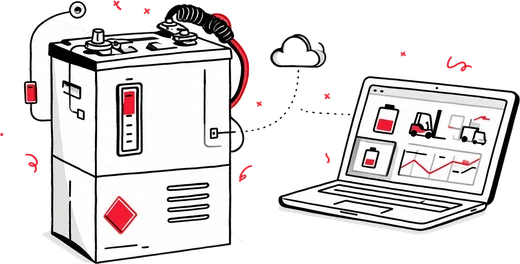
Connected test and measurement instruments
Cross-platform companion applications (Windows, Android, iOS) for a leading test and measurement company. The app connects wirelessly via Bluetooth to field instruments, downloads trace and measurement data, and enables technicians to annotate results and generate professional reports on-site. It eliminated manual paperwork and enabled instant collaboration from the field. We’ve worked on both the device side and the application side.
Test & measurementTempo Communications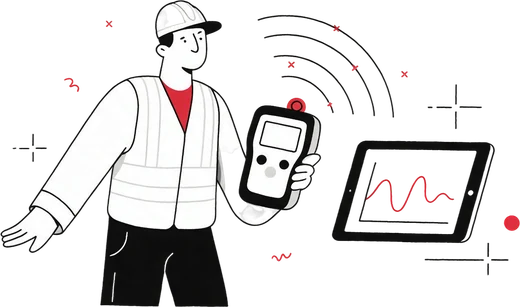
Distributed solar and storage operations platform
The core web platform for a cleantech company managing hundreds of megawatts of distributed solar capacity across thousands of sites. The system ingests real-time data from inverters, meters and sensors, delivers automated alerts and performance analytics, tracks SLA compliance, and provides multi-tenant dashboards for asset owners and operators. We work on the entire stack, from inverter integration to dashboard building.
Solar & storage operationsPopular Power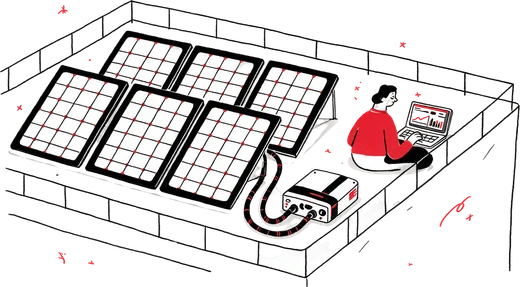
Deep integration. Shared ownership.
Why hardware teams work with us
Deep ESP32 and BLE expertise
Production-proven experience on the ESP32 platform, including low-level firmware and deep work in the BLE stack on both sides of the connection: the device firmware as peripheral and GATT server, and the companion mobile and desktop apps as central and client. From register-level radio configuration to the interface a technician uses in the field, we own the whole communication chain.

Full-stack ownership
One team covers firmware through frontend. No handoffs between agencies, no integration gaps, no lost context between layers.

Dedicated teams
Engineers assigned to your product for the long haul. They learn your domain, your codebase and your users, and they stay.
Agile delivery
Sprint-based development with continuous visibility. You see working software every two weeks, not a surprise at the end of a quarter.

AI is part of how we work
Our engineers use AI tools across design, development and testing, within your security and data policies and to the same review and testing standards as everything else we ship. It shortens the path from backlog to release. When your system is ready for it, the same team can build AI into the product itself. See AI.

No single point of failure on our side
You’re backed by a full engineering company, not a handful of contractors. Knowledge is shared and documented across the team, so one departure doesn’t stall your roadmap.
From first call to first release
How an engagement starts
Talk to an engineer.
A call with someone who has shipped firmware, connectivity stacks and companion apps, not a sales pitch.
We audit the hardware.
Your devices, your firmware and your connectivity path, and where the chain from device to app currently breaks.
First working release in 4 weeks.
A real slice of the product, such as a working device-to-app connection or a companion app, so you can judge us on shipped work.
Handoff or ongoing support.
Take the work in-house, or keep us on as the team that runs it. See engagement models.