
Renewable Energy
Engineering for companies building solar, storage and pay-as-you-go energy products
Battery packs, solar sites and pay-as-you-go units all report data constantly. We build the software that turns it into a product your customers pay for. We already know the domain, so you won’t spend your runway explaining state of health, SLA penalties or how a PAYG credit code works.
- Batteries
- Built the state-of-health analytics for a NASDAQ-listed lithium-ion manufacturer
- Solar
- Engineering partner to a solar monitoring platform covering 700+ MW across ~14,000 sites
- Tenure
- Our longest energy engagement, 4+ years and still shipping
- Next step
- Book a 30-minute call
The hardware reports. What happens next is the product.
Overview
A health score a fleet manager actually trusts. An alert that reaches the right person before a production guarantee slips. A payment that turns a customer’s power back on without a field visit. The data for all of this already exists; the software that acts on it usually doesn’t.
That’s the layer we build for our clients. For batteries, it means turning BMS telemetry into state of health and fleet-wide insight. For solar, it means monitoring and SLA tracking across thousands of sites. For energy access, it means payments and reconciliation that still work when customers pay in cash, far from a field office.
-
Battery health analytics
State-of-health algorithms built on BMS telemetry, with fleet-wide views of charge, usage cycles and charging behavior.
-
Solar portfolio monitoring
Site status, generation and alerts across every site, on one map.
-
Performance and SLA tracking
How close each site is to its commitment, before the client asks.
-
Alert management
Faults routed to the right person and tracked through to resolution.
-
Pay-as-you-go payments
Self-service top-up, unlock codes, auto-pay and reconciliation with platforms like Angaza.
Not hypotheticals
Relevant work
Battery state-of-health analytics
Flux Power makes lithium-ion packs for forklifts and airport ground support equipment, each with a BMS handling cell balancing, charging and telemetry. Flux needed a reliable way to turn that telemetry into a health measure its fleet customers could act on. For Flux, we built the state-of-health algorithm and the fleet monitoring and analytics interface on top of it. The interface shows state of health, state of charge, usage cycles and charging behavior across a fleet, so managers can spot a degrading pack before it causes downtime. Our reporting also feeds Flux’s own SkyEMS energy-management platform.
Battery fleet analyticsFlux Power (NASDAQ: FLUX)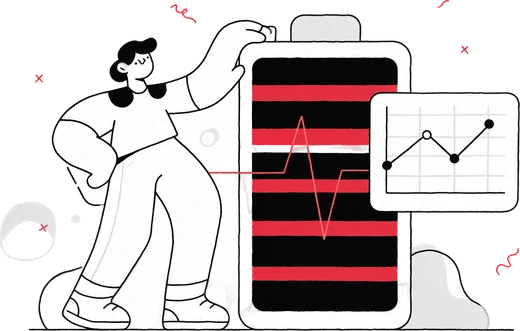
Outcome: Real-time monitoring of battery health, state of charge, temperature and usage patterns across tens of thousands of deployed battery packs powering forklifts, airport ground support equipment and autonomous vehicles.
Distributed solar monitoring platform
Popular Power’s platform helps solar developers, asset managers and O&M providers run distributed portfolios, and now covers 700+ MW across roughly 14,000 sites. Since August 2024 we’ve been part of their engineering team, building site status and generation tracking, the alert center, the interactive site map, SLA tracking, yield and CO₂ reporting.
Solar & storage monitoringPopular Power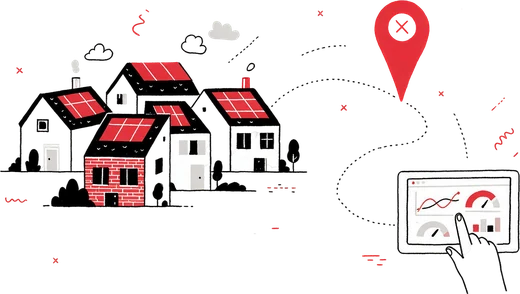
Pay-as-you-go solar payment portal
Navajo Power Home installs residential solar across the Navajo Nation and sells power pay-as-you-go. We built their customer payment portal. Customers sign in with the account number on their unit, see how many days of credit are left, pay by card, and get the code that restores power on the spot, at any hour and without a field visit. The portal sits on top of Angaza, their PAYG platform, and reconciles continuously, so cash paid to a field agent yesterday shows in today’s balance.
Pay-as-you-go solarNavajo Power Home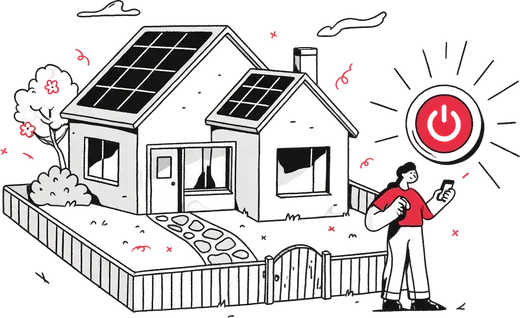
The difference shows in the first month
Why energy teams work with us
Plenty of agencies can build a dashboard. What matters is whether, a month in, your engineers are still explaining the domain or already reviewing shipped work.

Domain fluency from day one
State of health, generation against potential, SLA commitments, PAYG credit logic. Your first sprint goes into your product, not into teaching us the terms.

We build on what you already run
Your BMS, your inverter integrations, your payment platform, your cloud. We extend them rather than asking you to replace them.

We stay
Our longest energy engagement has run continuously since 2024. Energy platforms keep growing, and the team that built yours should still be there when they do.

The whole stack, in-house
When the product needs firmware changes, better connectivity or predictive models, the same team covers it. See Embedded Systems and AI.

AI is part of how we work
Our engineers use AI tools across design, development and testing, within your security and data policies and to the same review and testing standards as everything else we ship. It shortens the path from backlog to release. When your system is ready for it, the same team can build AI into the product itself. See AI.

No single point of failure on our side
You’re backed by a full engineering company, not a handful of contractors. Knowledge is shared and documented across the team, so one departure doesn’t stall your roadmap.
From first call to first release
How an engagement starts
Talk to an engineer.
A call with someone who has shipped battery, solar or PAYG products, not a sales pitch.
We learn your stack.
Your BMS and hardware integrations, your payment platform, and where the data currently breaks or goes unused.
First working release in 4 weeks.
A real slice of the product, such as a fleet health view, a portfolio dashboard or a payment flow, so you can judge us on shipped work.
The team grows with your roadmap.
Start small and scale up when it makes sense. See engagement models.